Use a concrete scope boundary to support a photo-organizing session, with a small practice task and a clear finish condition. This worked guide uses a small reproducible example so you can check the result before adapting it to your own task.
Zanim zaczniesz
- A notebook or plain-text notes app
- A small task that fits within about 30 minutes
- Only the materials already needed for the chosen activity
Poradnik krok po kroku
Choose a small real task
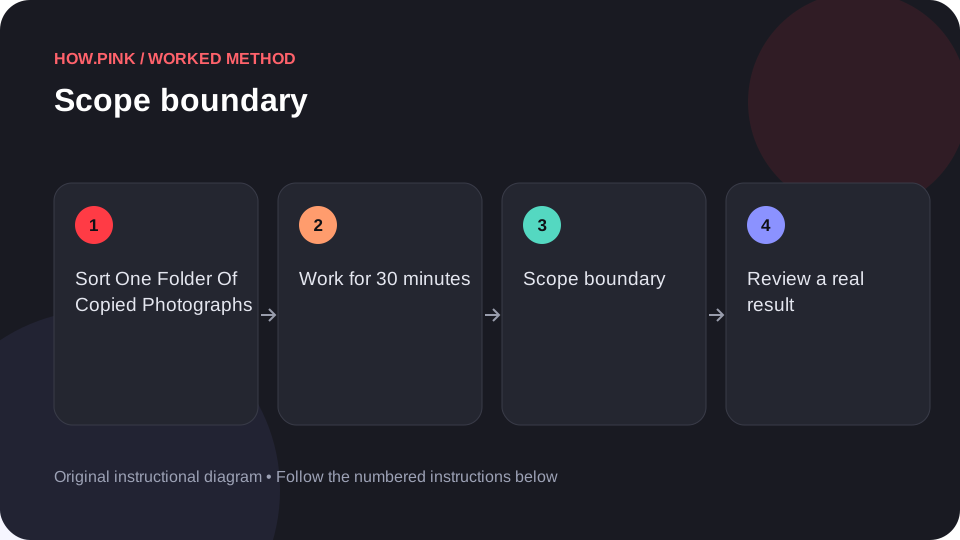
For this worked example, the task is to sort one folder of copied photographs. Set aside approximately 30 minutes. The intended result is a clearly named sample folder and an untouched original copy. Keep the scope small enough to complete a full attempt rather than only preparing for it.

Create the scope boundary
Draw two headings: Essential and Optional. An item is essential only if the stated outcome cannot be reached without it. Finish essentials before expanding scope. Use the example task—sort one folder of copied photographs—when filling it in, so the note describes an actual action instead of an abstract goal.
Write a concrete practice version
Use these starting details, then replace them with your own.
Task: sort one folder of copied photographs.
Available block: 30 minutes.
Expected output: a clearly named sample folder and an untouched original copy.
First check: confirm the required materials are already available.
Final check: find the output and compare it with the stated result.
Add the method-specific scope boundary from the previous step beside these details.
Use it during one complete attempt
Carry out the small task using the note. When an obstacle appears, record what happened and make a reversible adjustment. Keep the original intended result visible: a clearly named sample folder and an untouched original copy. Stop at the agreed finish condition and record anything that remains.
Check the result and keep a useful revision
Confirm that you have a clearly named sample folder and an untouched original copy. Read the scope boundary again and identify one instruction that was helpful and one that needs to be clearer. Save the revised note with a descriptive name so the next photo-organizing session can begin with a tested example.
Wskazówki i rozwiązywanie problemów
- Keep the note short enough to use while doing the task.
- Treat this as a practice method and adapt it to your actual constraints.
- Use copies when organizing digital files; check the result before changing originals.
Częste pytania
What if the task takes longer than expected?
Stop at a clear pause point, record the current state and next action, then revise the scope or schedule using what you learned.
How detailed should the note be?
Include the information needed to begin, check the result and resume later. Remove detail that does not help one of those actions.